




Former Arizona National Guardsman Phil Roux will never be able to make magic force fields for his military brethren. But thanks to his invention of portable, rapidly deployable ballistic systems developed through his company, Southwest Armor Technologies (SWAT Armor), he’s getting pretty close.
“Imagine these small structures folded down on a pallet; you can drop them on the back of transport vehicles and easily deploy them forward,” said Roux, who spent a decade in the Guard, some in an engineer company. “You could have this material almost like plywood to make a hasty quick base, or at least put up a secure barricade to control a roadway so someone can’t drive up and shoot at you.”
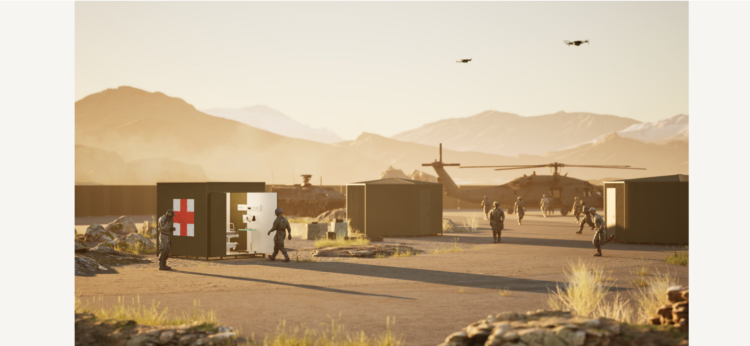
Founded in 2005, SWAT Armor, which became the first U.S. company to receive patents for bullet deflection technology in 2022, aims to save lives in combat zones and other dangerous situations. These latest ballistic systems came about after a surgeon, who had saved Roux’s life following a car accident, asked him two years ago to find a way to save medical staff on the front lines. The result was what Roux, SWAT Armor’s co-founder and CEO, jokingly calls “MASH 2.0, because canvas tents don’t cut it anymore.”





















“We sent it off for third-party testing and our top three levels of protection passed,” said Roux, who also has backgrounds in law enforcement and business. “It obviously works, and we proved we could do it.”
The concept behind the system is simple: imagine someone shot an arrow at you. It will certainly injure you, probably severely — unless something or someone taps the front of the arrow before it reaches you. Working with “space-age” thermoplastics and specific geometric shapes on those thermoplastics, Roux invented the technology with advancing drone warfare in mind.
“We had to create a system that was dependable, durable and lightweight enough that it could be carried further, dropped closer to the front lines, and quickly erected for medical staff to get inside and work,” Roux said. “It’s going to be produced in 4×8 sheets that will be sacrificial, where it allows the projectile to penetrate, but the exterior layer will chew it up a bit and contain it.”
The next step, happening in the next few weeks: build a few structures out of the material and take them to the Marine Corps Air Ground Combat Center in Twentynine Palms, California, for real-world testing. After that comes military shows and sales to the European market before eventual usage in actual warzones.
But Roux is confident it will happen someday — and his time as a guardsman is one reason why.
“One of the things the Guard taught me was self-reliance and taking my problem-solving skills to a whole new level,” said Roux.
One captain, in particular, taught him the importance of knowing your team’s capabilities, a lesson he brought over to SWAT Armor.
“You don’t get to pick who you work with in the military. You can’t say, ‘I’m going to fire four of you,’” Roux said. “You have to figure out ways of understanding the potential of everyone you work with, to make the mission successful, and that’s what I’ve tried to take into the civilian world.”
So far, it’s working.
“If we could protect our troops and provide a structure where our soldiers can be safely resuscitated and then transported back to safety, that’s our main goal,” he said. “There’s nothing like it right now in the world.”
For more information on SWAT Armor, see swatarmor.com.