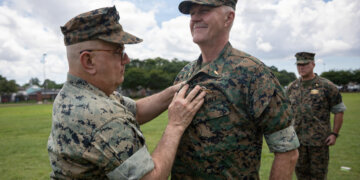





A sergeant major in the Marine Reserve is using decades of experience in and out of uniform to improve health care for service members, retirees, veterans and their families.
As the senior enlisted leader of Marine Light Attack Helicopter Squadron (HMLA) 773, Sgt. Maj. Ted Painter has spent years guiding fellow Marines through the challenges of balancing military service, civilian careers and family life. One case, recently resolved after years, stands out. Painter supported a SNCO on his staff who struggled to secure specialized health care for his children with special needs after transferring to the unit.
“It took them a good six years to get stable,” Painter said. “They even went out of pocket for respite care, even though they were eligible for coverage. His wife, from an employment perspective, struggled because she had to take care of the kids who weren’t getting the care they needed.”



















With 23 years of service – 10 of them on active duty – a spouse, and five children of his own, Painter understood the pressure, compounded with the demands of the Marine Corps, this family was under. The sergeant major worked behind the scenes so the SNCO could extend his assignment, ensuring he wouldn’t receive new orders while still trying to stabilize his family’s care plan.
In his civilian role, Painter is the associate vice president of market operations for CareSource Military & Veterans™ (CSMV). From that vantage point, he said he knew even more could’ve been done to assist this family, who are enrolled in the Exceptional Family Member Program (EFMP), with specialized health coordination.
“That’s always been a challenge, because the Marine Corps wants to move them, but they’ve got this situation at home that a move could be catastrophic,” Painter said. “We had to work through quite a bit, but an organization like CareSource could’ve come in for a situation like that, and sort of taken over from a care coordination perspective that the family is just not going to get from traditional TRICARE.”
CSMV recently announced its partnership with the Defense Health Agency (DHA), giving eligible TRICARE beneficiaries the option to select CSMV as their health plan during TRICARE’s 2025 Open Season (Nov. 10– Dec. 9). The TRICARE Prime® Demo by CSMV aims to maintain the comprehensive coverage TRICARE beneficiaries expect, while introducing some new features.
Holly Joers, CSMV market president, said the partnership with DHA is built on a shared commitment “to serve those who serve and to deliver high-quality care that meets families where they are.” The plan features referral-free access to in-network specialists, a single point of contact to assist with connecting beneficiaries to the right providers, and medical record transfers for seamless continuity of care.
“Military families deserve choices that reflect their lives,” Joers said. “That means support that is personal, communication that is clear and care that feels connected.”

CSMV is the military-focused division of CareSource, a nonprofit managed care organization. There is no additional cost to choose the TRICARE Prime® Demo by CSMV; standard costs apply based on a beneficiary’s respective coverage group. Nearly 150,000 TRICARE beneficiaries live in the pilot areas – Tampa, Florida, and Atlanta, Georgia, where the demo is set to launch. The pilot will test how the CareSource model performs in a community with military treatment facilities (Tampa), and one without (Atlanta). After the trial, DHA has the final say on whether to expand the program in other locations.
“CareSource Military & Veterans brings a community-first approach to military health care,” Joers said. “We understand that access is more than appointments. We combine our national expertise with deep local partnerships to make it easy for families to connect to trusted providers and support.”
After nearly a decade at CareSource, Painter said he’s excited to launch a program that allows him to stay connected and focused on the needs of the community he serves. He added that having a team made up of veterans, military spouses, and others who speak the language and whose shared experiences can inform the program, is critical to its success.
“This has to be authentic,” Painter said. “We’re not going to be like everybody else, because everybody else doesn’t necessarily meet the mark for what military families deserve. We have to know what we’re talking about, what they’re saying, and we have to understand what they’re experiencing. The more and more of our team that we can have with that shared experience, the better.”
Visit CareSource Military & Veterans to learn more.