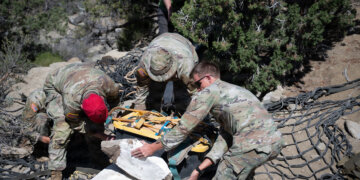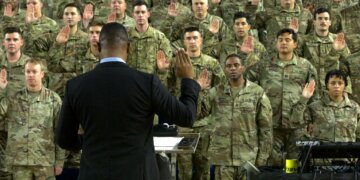






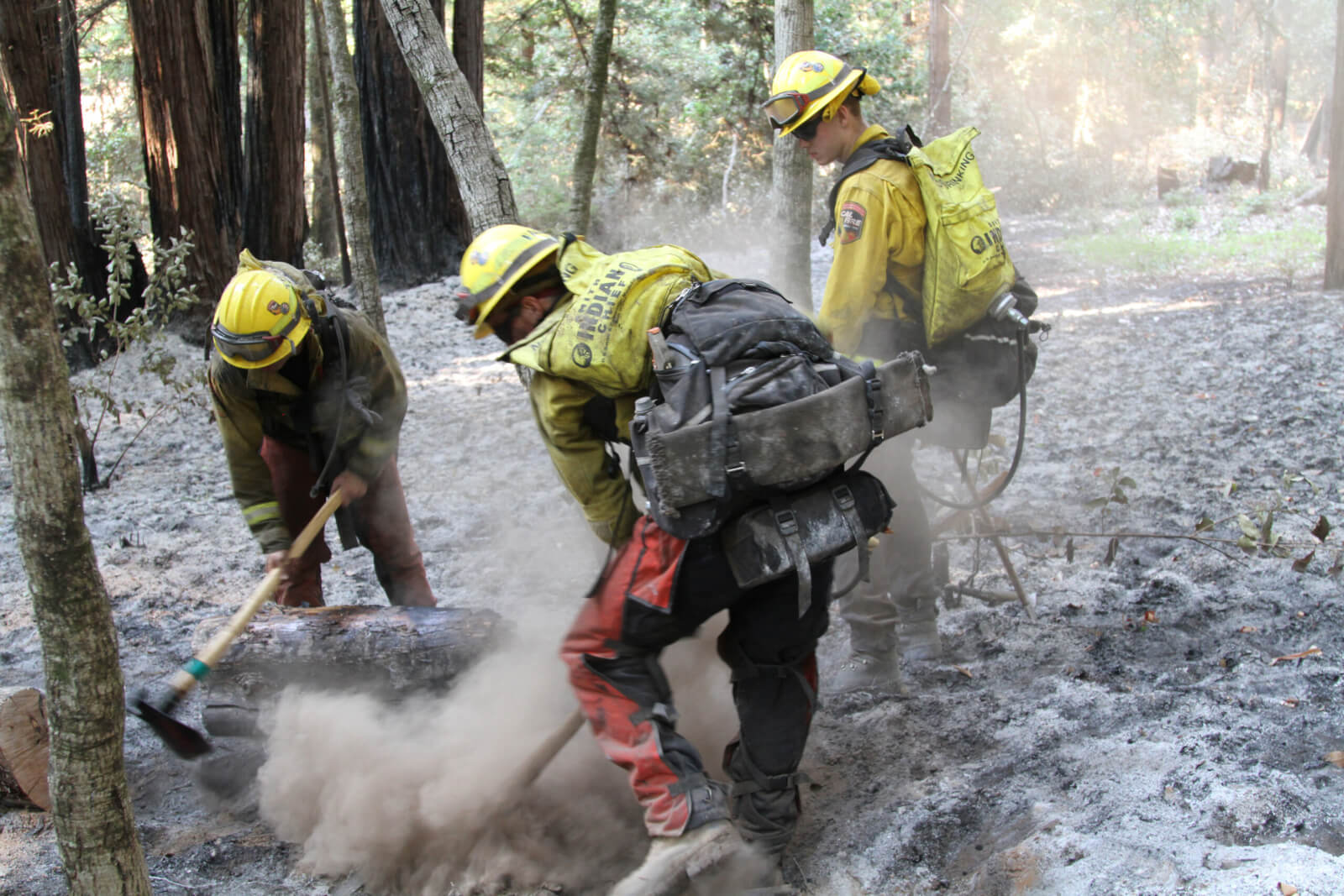
Specialized crew members from the California National Guard were rerouted last week from Los Angeles to assist the state in battling wildfires, according to California Gov. Gavin Newsom.
Teams from Task Force Rattlesnake, which comprises more than 300 Cal Guard members partnering with the California Department of Forestry and Fire Protection (CAL FIRE), are responsible for “clearing brush, cutting fire lines, and deploying on the frontlines of the state’s peak fire season.” Newsom and President Donald Trump have been locked in a battle over the federalization of California’s guardsmen since early June when “numerous incidents of violence and disorder” broke out involving U.S. Immigration and Customs Enforcement (ICE) operations.
Legal battles ensue
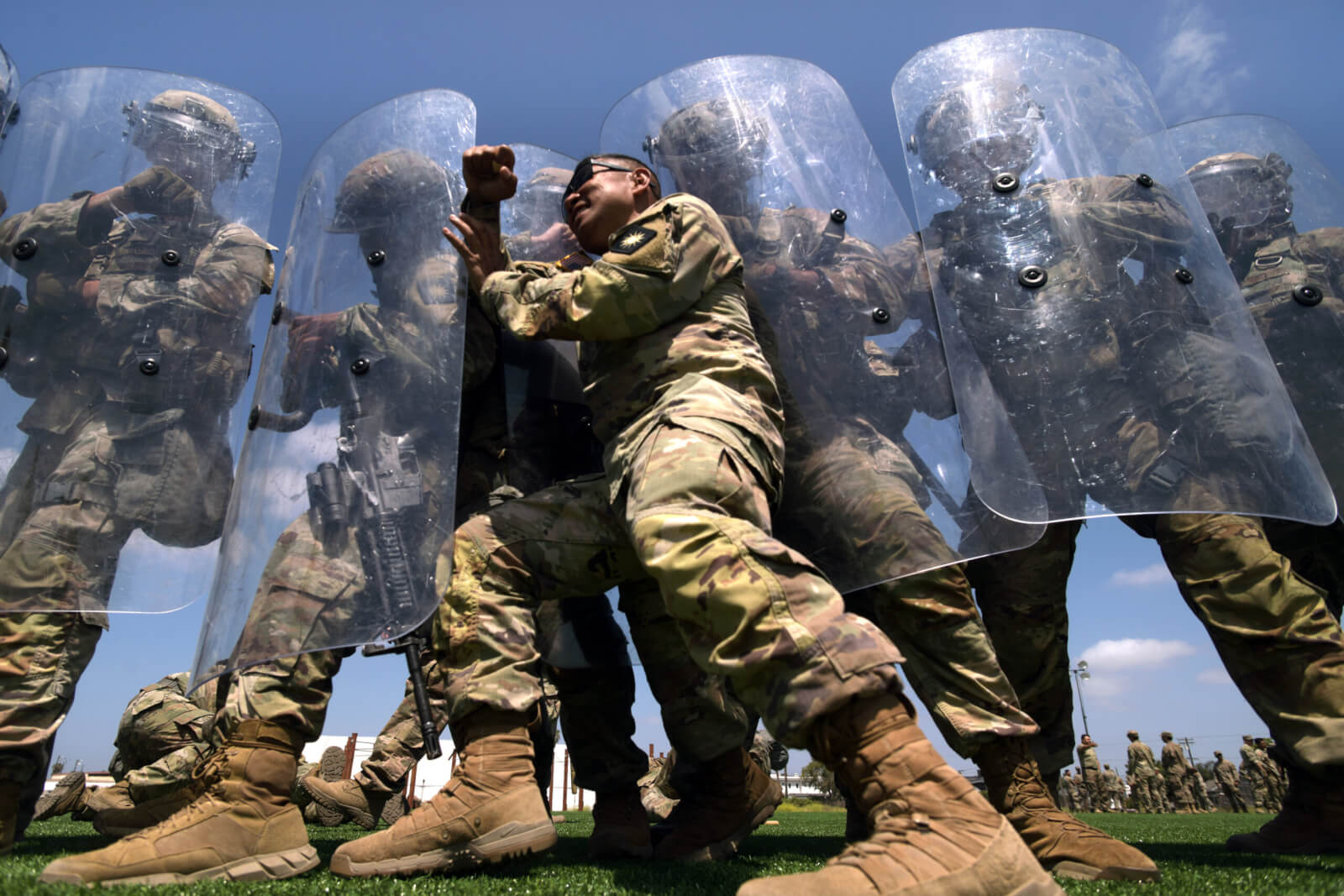
On June 7, in response to “violent protests” against ICE in Los Angeles, Trump ordered the mobilization of California National Guard soldiers under Title 10 of the U.S. Code. As guardsmen rolled out to protect ICE agents on their missions to detain undocumented immigrants across the city, a furious legal battle began.























California sued the Trump administration in federal court on June 9, claiming that the president falsely called the situation in Los Angeles a rebellion in order to unlawfully bypass Newsom’s authority over the California National Guard.
“At no point in the past three days has there been a rebellion or an insurrection,” the lawsuit stated.
California Attorney General Rob Bonta told CBS News that federalization of the National Guard “stokes the flames” of civil unrest in the city.
“The authority that the president cites only allows for the deployment of the National Guard by the president when there’s an invasion by a foreign nation, which there’s not, when there’s a rebellion to overturn leadership of the United States of America, which there’s not, or when the regular forces of the federal government cannot execute the law, which is also not present,” Bonta said.
U.S. District Judge Charles Breyer temporarily enjoined the Trump administration from deploying the California National Guard in Los Angeles on June 12, saying that the president’s “actions were illegal — both exceeding the scope of his statutory authority and violating the Tenth Amendment to the United States Constitution.”
Breyer wrote that the administration’s claim it had unilateral authority to deploy troops against the will of a state “threatens serious injury to the constitutional balance of power between the federal and state governments [and] sets a dangerous precedent for future domestic military activity.”
On June 19, a three-judge panel for the U.S. Court of Appeals for the 9th Circuit granted the Trump administration’s request for an emergency stay of the district court’s temporary restraining order.
“Under longstanding precedent interpreting the [statute], our review of that decision must be highly deferential,” the court said. “Affording the President that deference, we conclude that it is likely that the President lawfully exercised his statutory authority.”
Additionally, the court determined that Newsom has no veto power in this circumstance. The statute says the deployment must go “through” the governor, but according to the appellate court, that simply describes a procedural mechanism and does not grant Newsom authority to override the president’s decision.
A ‘fascinating and troubling’ case
Daniel Maurer, associate professor of law at Ohio Northern University and former Army JAG officer, disagrees with the decision of the appellate court.
“They gave no attention to the lower court’s rejection of the administration’s ‘rebellion’ argument and instead concluded that Trump’s ‘unable to execute the laws with regular forces’ argument was sufficient,” he said. “Either one would be, if the facts on the ground actually merited those conclusions.”
Maurer, a 22-year veteran who held high-level positions at the Pentagon, the U.S. Military Academy at West Point, and other Army installations through the course of his military legal career, described the arguments in the case as “fascinating and troubling.”
“He has not invoked the Insurrection Act, which means the Posse Comitatus Act is still the default setting,” he said during a recent conversation with Reserve + National Guard Magazine. “That means military cannot be used for law enforcement. So then that begs the question, what exactly is the California Guard being asked to do?”
“The Department of Defense’s protection mission allows the Department of Homeland Security law enforcement personnel to focus on performing law enforcement functions and effectively enforcing immigration laws,” a spokesperson from U.S. Army North Task Force 51 Public Affairs told Reserve + National Guard via email.
Maurer worried that the line between protection and active participation might be easy to cross in the heat of the moment.
“Engagement may feel different, look different, when you’re staring down the barrel of the proverbial gun,” said Maurer. “How that actually works in practice may look very different than how it looks on paper, which is why we have JAGs embedded in units at almost every level of command to help train those soldiers on rules for the use of force and the law in situations that might be confusing.”
An officer in the California National Guard who spoke on condition of anonymity confirmed that there is heavy involvement from active duty JAGs on the mission.
“They’re very thorough,” he said. “They are very deliberate in explaining what our roles are going to be when we go out there to help ICE on an operation, to make sure that we don’t blur the lines, make sure that we stay within our limits as Title 10.”
U.S. Army North emphasized that all military members are to follow the standing rules for the use of force (SRUF). “Service members are trained in de-escalation techniques and always retain the inherent right to self-defense to a hostile act or demonstrated hostile intent,” the spokesperson said. “Military members may also take actions to provide for the defense of others as well as the defense of property, using the minimum necessary force.”
‘It’s like this deployment doesn’t exist’
The anonymous guardsman was disheartened to see the legal dispute affect the execution of the mission. “At the political level, it got ugly for the National Guardsmen,” he said. “There’s a lot of pettiness between the California Military Department and the active-duty component. The California Guard basically signaled to the subordinate units that, ‘hey, because you’re on Title 10, you’re cut off from us, you’re on your own.’”
As examples, he cited guardsmen being banned from using their own armories, needing to cover California National Guard placards on their shields, and receiving no public support on social media.
“If we were deployed to the Middle East right now, the Cal Guard would be posting photos of the soldiers saying goodbye to their significant others or arriving on a plane,” he said. “But if you look at X, they’re not even mentioning it. It’s like this deployment doesn’t exist.”
He had praise for U.S. Army North stepping up to provide resources for the guardsmen, despite delays due to lack of access to pre-existing infrastructure on the ground.
When reached for comment, the California Military Department referred all queries, including those related to facilities and equipment, to U.S. Army North Task Force 51.
As of June 23, there were approximately 4,000 California National Guardsmen activated to the mission in Los Angeles. Currently, the California National Guard has orders for a 60-day deployment, set to conclude on Aug. 7.