


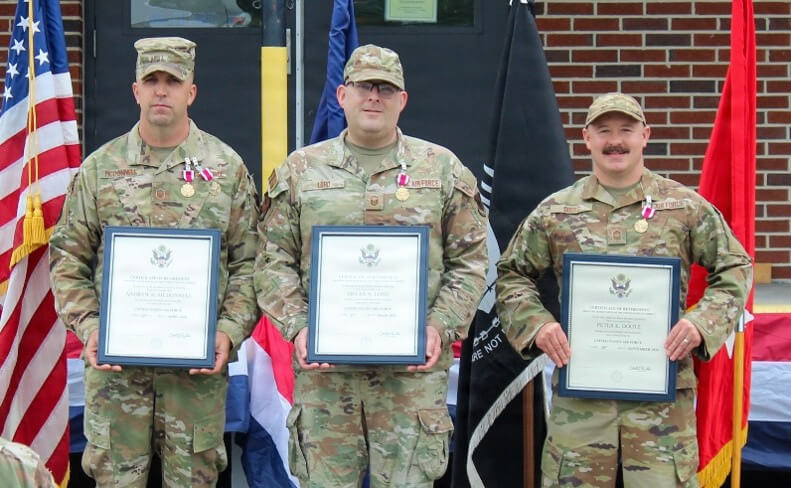
This June, three Maine Air National Guard airmen assigned to the 265th Combat Communications Squadron retired together. All three shared their initial thoughts on the retirement process and what the future might bring.
Master Sgt. Bryan Lord, a warfighter communications superintendent, enlisted in 2004 and spent 22 years as a full-time airman. But his military career didn’t have the typical ending.
“I struggled a lot with the PT program, and as I got older it didn’t get easier,” Lord explained. After failing the test that cumulatively “broke the camel’s back,” he was demoted.























“Once that happened, me and my significant other were just kind of like, ‘All right, maybe it’s time to call this,’” he said. Post-retirement, he was rehired under Title V and now serves as a civilian employee.
Lord is glad he won’t run the same risk most retirees do of losing the bonds he built with his fellow airmen.
“Usually people come to a lot of unit functions at first, and then it fizzles out. But I’m there looking at the same people, wearing business casual instead of a uniform, with my new beard.”
Lord advises airmen and guardsmen who are considering retirement to gather as much information as they can before they leave.
“You hit that retirement date, you filed, you’re gone,” he said. “The ball’s in the individual’s court to make sure they have pursued anything they’re due.”
Master Sgt. Carie Page, of the 101st Air Refueling Wing’s Force Support Squadron, supports the retirement process for airmen and agrees with Lord. She suggests starting early.
“Don’t try to get everything pushed through the wickets at the last minute,” she said.
She also cautions against trying to do everything alone.
“It has become a self-service action, but you can lean on us. This is our bread and butter; we do it every day.”
Page sees many people who haven’t mentally prepared for the transition.
“You can see the stress all over their face,” she said.
Senior Master Sgt. Peter Dootz tried to get ahead of that process. In 2022, 20 years after enlisting, he transitioned from a full-time radio frequency transmissions and electromagnetic activities craftsman to a part-time role. Balancing his time as senior enlisted with his new experiences in the corporate world gave him a head start to retirement.
For Dootz, the key is matching your military skill set to your civilian career plan.
“You’re middle aged, you’re probably gonna keep on working,” he said. “You can walk into your civilian life how you want to, on your terms.”
Dootz is building a new community by participating in robotics programs with his 13-year-old son.
“I guess the mission’s changed,” he said. “Now it’s focusing on my kids. I felt like it was time to open up space for other folks and pass the torch.”
IT systems technician craftsman Master Sgt. Andrew McDonnell had a similar realization of when his tenure was done.
“My replacements were right there and already doing a better job than I was,” he laughed.
Unlike Dootz and Lord, McDonnell spent 20 years on the part-time ANG path, so he already had a flourishing business in home construction. Between work responsibilities and wanting to spend time with his kids while they were still young, his priorities became clear. His suggestion for people on the verge of retirement is to lean on those who have gone before.
“I called a couple of people who had retired within the past year or two and picked their brain. That’s where I got the most info.”
McDonnell will miss the bonds he created in the ANG, but he thinks he made the right choice.
“It’ll create a void, I’m sure,” he said. “But I’m gaining back time with friends and family. There’s a sea plane flying up on Moosehead Lake that I went to as a kid, and it always landed on my first weekend of the month, without fail, for the past 20 years. This year, I’m going.”